






Services
© 2026 MSB Group. All rights reserved.
MSB Group UK is the trading name of MSB Steel Ltd
Created by Just Chill
New Premises
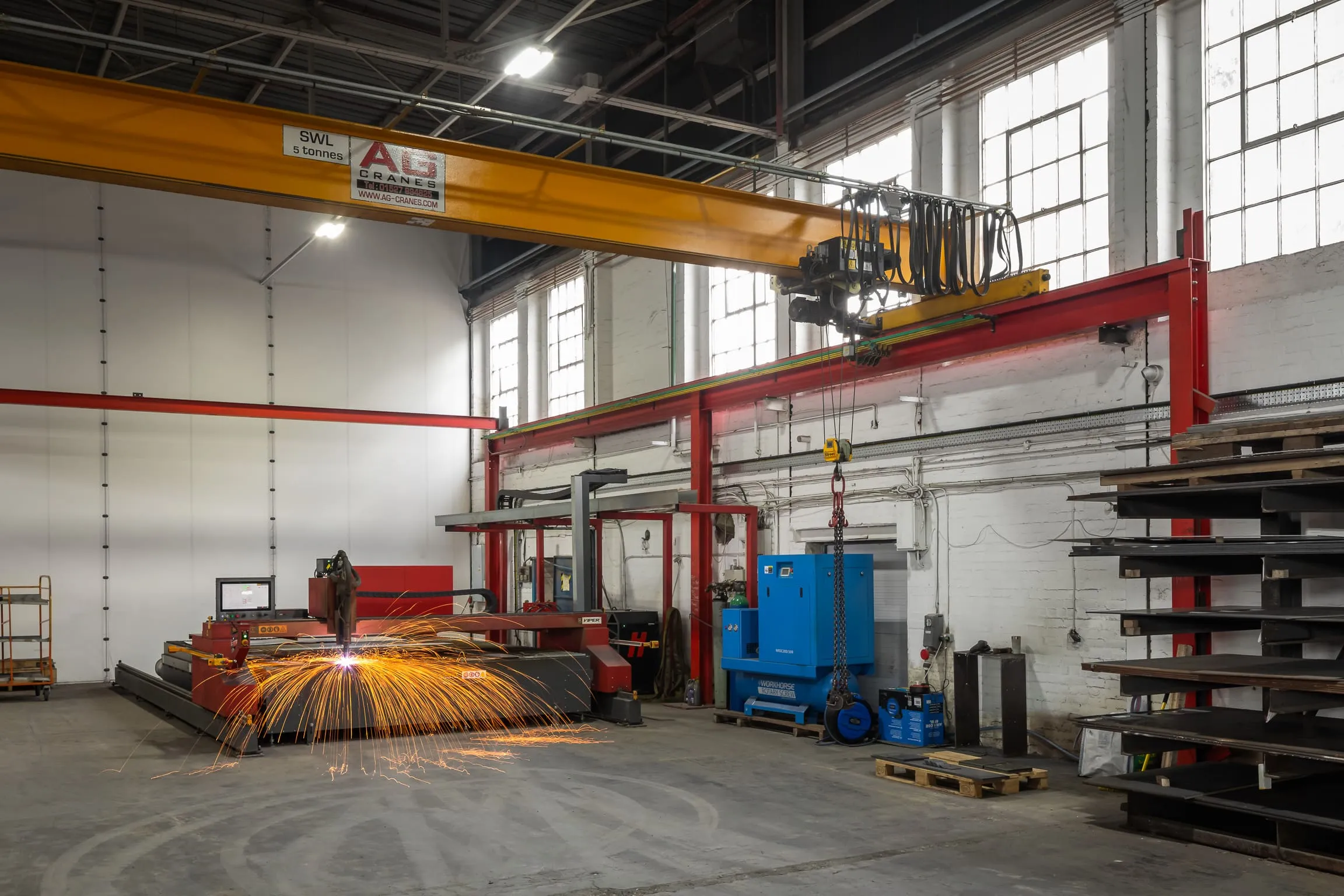
The CNC laser cutting machine in MSB Group's fabrication workshop.
MSB fabricates structural steel in its own 45,000 sq ft Gloucestershire workshop, with a 6kW CNC fibre laser and its own delivery fleet. For clients, one team controls fabrication, delivery and erection. Here is what that changes and which certificates to ask any steel fabricator to show.
Most buyers never see the workshop their steel comes from, and a site visit tells you less than the paperwork does. What matters is who holds the factory production control certification, what Execution Class the steel is fabricated to, and whether the firm quoting you is the firm doing the work.
In plain terms, a fabricator is the factory stage between the engineer's design and the crane on site.
A steel fabricator turns engineering drawings into the steel members that make up a frame: columns, rafters, beams, bracing, base plates and connections. The work runs in a sequence. Drawings are produced for the shop, steel is cut to length and shape, holes are drilled, pieces are assembled and welded, and the finished members are coated, marked and dispatched in an order that suits erection on site. Every stage is a place where quality is made or lost, which is why the certificates below exist.
On a steel framed building, the frame is what sets the programme. If the steel is late, everything behind it is late: cladding, doors, fit-out. When fabrication is bought in from a separate firm, the fabricator has its own order book and its own priorities, and you have no direct say in them.
Fabricating in our own workshop removes that handover. The design, fabrication and erection teams all work for MSB, so the site team can see what is coming and when. If a detail needs changing, it is a conversation within one company, not a chain of emails between three.
Plate parts are small in tonnage but large in number. A portal frame has base plates under every column, cleats and end plates at every connection, and brackets for purlins and rails. Cutting these from a digital drawing means each repeat part matches the last, holes land where the drawing puts them, and the pieces fit on site without being reworked. It also lets us make one-off parts for a particular detail in-house instead of waiting on a supplier. Our portal frame explainer shows where those plates sit in the frame.
45,000 sq ft
workshop space for fabrication and dispatch
6kW
CNC fibre laser for cutting steel plate to shape
There are three common set-ups on a steel framed project, and each puts the risk in a different place. In the first, a main contractor buys the frame from a separate fabricator and a separate erector. The contractor coordinates, but the fabricator and erector each have their own priorities, and a late delivery or a misfit lands between three companies. In the second, a fabricator supplies steel to site and a client or contractor arranges erection, which leaves the interface between supply and erection to the buyer. In the third, which is ours, one company designs, fabricates, delivers and erects. The advantage is not that nothing goes wrong; it is that when something does, the person who can change the drawing, the cut or the delivery is in the same building as the person who needs the change.
It is also easier to be open about progress. A client who asks how the steel is getting on can be told what has been cut, what is being welded and what is booked for delivery, by the people who are doing it, and the site team can plan labour and plant around real dates rather than estimates.
That matters most on programmes with fixed dates, such as a live site or a seasonal business, where a late frame has a direct cost. It also helps when a detail needs revising after the first inspection, because the revision does not have to pass through a purchasing chain.
Steel delivered on our own vehicles means the person planning the delivery knows the load, the sequence and the site. The Volvo FH500 articulated lorry carries the long members, and the Volvo FE rigid has a Fassi loader crane, so smaller loads can be unloaded on site without hiring in a crane for every delivery. Site access still has to be checked in advance, because long steel needs turning space and a firm place to stand. The packing order matters too: members should arrive in the order they are erected, so the crew is not digging through a stack for the next rafter.
Fabricated structural steel delivered to a site in Great Britain must be UKCA or CE marked against BS EN 1090-1. To get there a fabricator needs factory production control, including a responsible welding coordinator and a welding quality system, and a UK Approved Body must inspect the plant and audit it each year. You can ask to see three documents: the factory production control certificate, the welding certificate, and the contractor's declaration of performance. The certificate shows the Execution Class the fabricator has achieved, and the engineer specifies the class the job needs. For most buildings in the UK that is Execution Class 2.
MSB holds Constructionline Gold and SafeContractor accreditation, UKCA marking, and UKAS-accredited SCCS certification for structural steelwork. These are the documents a client or principal designer will ask for in a pre-qualification questionnaire, and we are happy to send current copies on request. Our guide to how to check a contractor before you sign lists the other checks we would make in your position.
Ask where the steel is fabricated and whether that is the same firm that is quoting. Ask to see the factory production control certificate and the Execution Class it covers. Ask who delivers and who erects, and whether that is the fabricator's own team. Ask how long fabrication takes from approved drawings, and what happens to the programme if a detail changes. And ask how the steel is protected for the environment it will sit in, since coating needs depend on the building and its location. A fabricator who answers in specifics is easier to plan around than one who answers in general terms.
If you are comparing fabricators or contractors, use the same checklist on each. Check that the factory production control certificate is current and covers the Execution Class your engineer has specified. Check the accreditations a pre-qualification questionnaire asks for, such as Constructionline and SafeContractor, and ask for copies. Ask for references on buildings of a similar size and type. Visit the workshop if you can, because the state of the shop floor, the way steel is stored and marked, and how the team talks about programme tell you as much as a certificate. Then compare the quotes on a like-for-like basis: the same frame, the same coating, the same delivery and erection scope. Price differences often come from scope differences.
Ask any contractor three things: where the steel is made, who delivers it, and who erects it. If the answer is three different companies, ask who is responsible when the programme slips. Our answer is one team, from drawing to handover, which is the point of the workshop. If you would like to see it, get in touch and we will arrange a visit alongside a conversation about your project.
Read more about our steel fabrication service, how fabrication prices move in our steel prices guide, and how the frame fits the whole job in our steel framed buildings service. To start a conversation, use our contact page.
BS EN 1090-1 sets the requirements for showing that fabricated structural steel meets its declared performance. In Great Britain steelwork must be UKCA or CE marked to it, and the fabricator needs certified factory production control.
Execution classes set the level of quality control for fabrication and erection. The engineer specifies the class, and class 2 is appropriate for most buildings in the UK.
It cuts steel plate to precise shapes from a digital drawing. In structural steelwork that means parts such as base plates, brackets and connection plates, made accurately and consistently.
Yes. We deliver on our own vehicles, an articulated Volvo FH500 and a Volvo FE rigid with a Fassi loader crane.
Yes. Contact us on 01452 452100 or sales@msbgroupuk.com and we will arrange a visit.
Related service
Structural steelwork fabricated in our own workshop and erected by our own team.
